You hang the picture. You step back. Something is off, but you cannot quite name what it is. The art looks like it is floating somewhere near the ceiling, disconnected from the sofa below it. Or the frame is so small against the wall that it looks like an afterthought. You move it. You try a different wall. You give up and lean it against the skirting board, where it has stayed for the past four months.
This is one of the most common decorating frustrations in any home, and it has nothing to do with taste or budget. It is a proportions problem — and proportions follow rules. Once you know the rules, arranging wall decor above a sofa stops being a guessing game and becomes a straightforward process with a predictable, good-looking result every time.
This guide gives you the exact measurements, layout rules, and decision frameworks that interior designers use. No more trial and error.
The Most Common Mistake Everyone Makes (And How to Fix It)
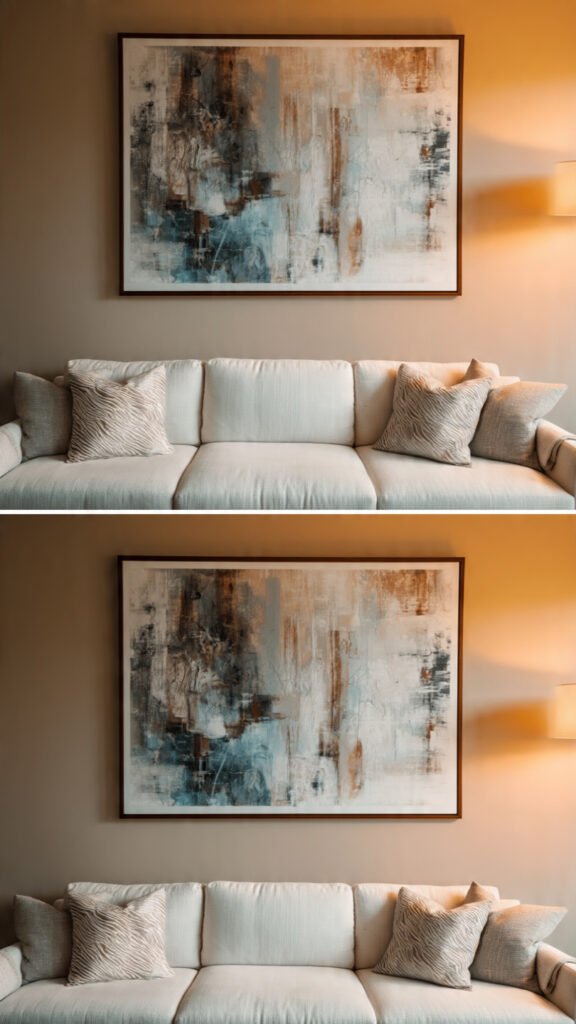
The single most widespread mistake when hanging art above a sofa is hanging it too high. This happens because most people default to eye level when standing — which places the art at roughly 57 to 60 inches from the floor. That height works well for art on an open wall with no furniture beneath it. Above a sofa, it creates an awkward gap between the top of the sofa back and the bottom of the frame that makes the two elements look completely unrelated.
The rule for art above furniture is different from the rule for art on an open wall. When hanging above a sofa, the bottom edge of the frame — or the bottom edge of the lowest frame in a grouping — should sit 6 to 8 inches above the top of the sofa back. Not 14 inches. Not 20 inches. Six to eight inches.
This gap is small enough that the art and the sofa read as a single composed unit rather than two separate elements competing for attention on the same wall. If your sofa back sits at around 36 inches from the floor, your art should begin at roughly 42 to 44 inches. The visual centre of the art will then fall at a height that looks intentional and grounded rather than adrift.
If you currently have art hanging above your sofa that looks wrong, measure the gap between the sofa back and the bottom of the frame. In most cases, lowering it by 6 to 10 inches is all that is needed to fix the entire composition.
The 3 Layout Rules That Always Work
Beyond the hanging height, three proportion rules govern how art above a sofa should be sized and arranged. These rules apply whether you are hanging a single large piece or a grouped gallery arrangement.
Rule 1: The width of the art should be approximately two-thirds the width of the sofa. If your sofa is 90 inches wide, the art or art grouping should span roughly 60 inches. Art that is too narrow looks timid and isolated. Art that is wider than the sofa visually overwhelms it and makes the room feel unbalanced. The two-thirds ratio creates a relationship between the two elements that feels considered rather than accidental.
Rule 2: For grouped art, treat the entire grouping as a single unit. When assessing proportions for a gallery wall or a multi-piece arrangement, measure the overall footprint of the group — the widest point side to side and the tallest point top to bottom — as if it were a single frame. That overall footprint should follow the two-thirds rule against the sofa width, and the bottom edge of the lowest frame in the group should observe the 6 to 8 inch gap above the sofa back.
Rule 3: The visual centre of the art should sit at eye level when standing. Eye level for most adults is between 57 and 60 inches from the floor. For a single piece, aim for the horizontal centre of the frame to fall at approximately 57 inches. For a gallery grouping, the visual centre of the whole arrangement should fall at that height. This rule works in combination with the 6 to 8 inch gap rule — if the two conflict, prioritize the gap rule, as the furniture relationship is more visible than the abstract eye level standard.
Single Large Piece vs Gallery Wall — Which Is Right for Your Space?
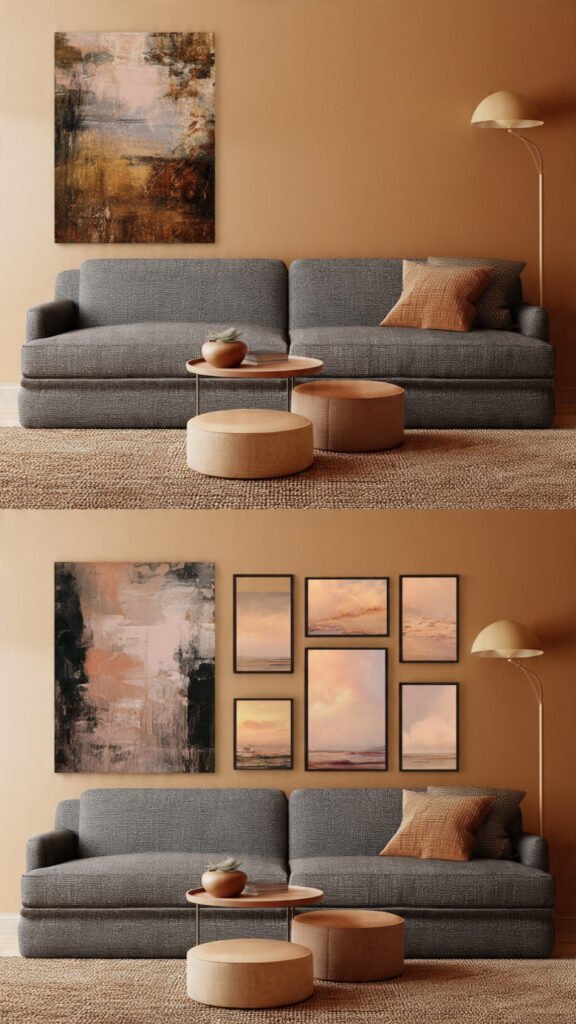
Both approaches work above a sofa, and neither is inherently superior. The right choice depends on the wall size, the sofa size, and the visual effect you want to achieve.
A single large piece works best in smaller rooms, on narrower walls, or when you want the space to feel calm and uncluttered. One well-chosen, correctly sized canvas or framed print above a sofa is the fastest way to make a living room feel pulled together. It requires less planning, less hardware, and far less decision-making than a gallery wall. The risk is choosing a piece that is too small — which is why the two-thirds rule matters so much here. A single piece that is too small will always look worse than a gallery grouping of the same total budget.
A gallery wall works best on wider walls, above longer sofas, and when you want the space to feel layered, personal, and collected over time. It allows you to combine different types of art — photographs, prints, mirrors, and objects — in a way that tells a story about the people who live there. The challenge is that it requires more planning to look intentional rather than chaotic. Done correctly, a gallery wall above a sofa is one of the most characterful features a living room can have. Done incorrectly, it looks like a notice board.
A simple decision framework: if your sofa is under 72 inches wide, lean toward a single large statement piece. If your sofa is 84 inches or wider and the wall behind it has significant horizontal space, a gallery arrangement will fill the wall more naturally and proportionally.
How to Create a Gallery Wall Above a Sofa Without It Looking Messy
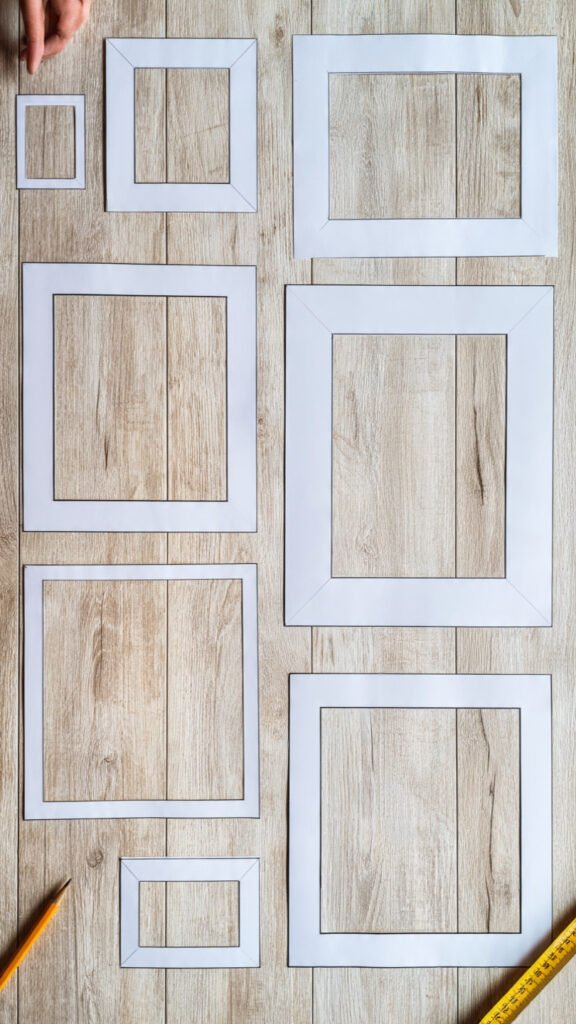
The reason most gallery walls look messy is that they were hung directly on the wall without planning the arrangement first. Frames were added one at a time, with each new addition responding to the last, until the overall composition drifted away from any coherent structure. The fix is to plan the full arrangement on the floor before a single nail goes into the wall.
Step 1: Lay everything on the floor. Arrange your frames on the floor in front of the sofa, roughly matching the width and height relationship they will have on the wall. Move things around until the arrangement feels balanced. Photograph it from a standing position so you have a reference image to work from when you move to the wall.
Step 2: Use paper templates on the wall. Trace each frame onto paper or brown wrapping paper, cut them out, and tape them to the wall with painter’s tape in the arrangement you finalized on the floor. This lets you see the full composition on the actual wall — including how it relates to the sofa below — before you commit to any holes. Adjust as needed until it looks right. This step takes 20 minutes and saves hours of filling holes and repainting.
Step 3: Start with the anchor piece. Once your paper templates are confirmed, remove them one at a time and replace each with the actual frame, starting with the largest or most central piece. The anchor piece sets the height and horizontal centre for everything else. All other frames are positioned in relation to it.
Step 4: Maintain consistent spacing between frames. The space between frames in a gallery arrangement should be consistent — typically 2 to 3 inches between each frame. Inconsistent spacing is one of the most common reasons a gallery wall looks disorganized even when the individual pieces are well chosen. Use a small piece of cardboard cut to your chosen gap measurement as a spacer while you hang each frame.
Step 5: Mix frame sizes, but limit colour variation. A gallery wall with all identically sized frames looks repetitive. A gallery wall with frames in three or four different sizes — a large anchor, a few medium pieces, and one or two small ones — has visual rhythm and interest. However, keeping the frame colours within a narrow range — all black, all natural wood, all gold, or all white — prevents the arrangement from looking like a jumble sale. You can mix sizes freely as long as the frame finish is cohesive.
What If Your Sofa Is Against a Window or You Have No Wall Space?
Not every sofa sits against a solid wall. If yours is positioned in front of a window, under a sloped ceiling, or in an open-plan space with no wall behind it, traditional wall hanging is not an option. There are several alternatives that achieve a similar composed effect.
Leaning art on a console table behind the sofa. A console table positioned directly behind a sofa creates a surface on which large-format art can lean freely without any wall attachment. A single oversized canvas or framed print leaning against the back of a sofa gives the same grounded, composed feeling as hung art, and works particularly well in open-plan spaces. The art should be tall enough that the top edge is visible above the sofa back.
Floating shelves as an alternative to hanging. Two or three floating shelves staggered above the sofa allow you to display art, objects, and plants in a layered arrangement without committing to fixed frame positions. Shelves can be repositioned as your collection evolves, and they add a three-dimensional quality that flat-hung art cannot achieve.
Tall plants as vertical anchors. In spaces where wall decor is genuinely not possible, a large floor plant positioned behind or beside the sofa provides the vertical visual anchor that wall art would otherwise supply. A fiddle-leaf fig, a tall snake plant, or a large monstera beside the sofa end creates height and life in the space without requiring any wall attachment at all.
The Specific Measurements to Use Every Time
Use this as a quick reference the next time you are planning wall decor above a sofa. These numbers work for the vast majority of standard sofas and ceiling heights.
| Measurement | Guideline |
|---|---|
| Gap between sofa back and bottom of frame | 6 to 8 inches |
| Ideal art width relative to sofa width | Approximately two-thirds of sofa width |
| Visual centre of art from floor | 57 to 60 inches |
| Spacing between frames in a gallery grouping | 2 to 3 inches |
| Minimum art width for a sofa under 72 inches | 40 to 48 inches |
| Minimum art width for a sofa over 84 inches | 56 to 64 inches (or a gallery group spanning this width) |
These measurements are starting points, not absolute rules. Rooms with unusually high or low ceilings, sofas with very high or very low backs, and non-standard wall configurations will all require slight adjustments. But in a standard room with a standard sofa, these numbers will produce a result that looks correct every time.
Frequently Asked Questions
How high should you hang art above a sofa?
The bottom edge of the frame should sit 6 to 8 inches above the top of the sofa back. This gap keeps the art visually connected to the sofa rather than floating independently on the wall. The most common mistake is hanging art too high — if something looks off above your sofa, lowering the frame is almost always the fix.
What size art should go above a sofa?
The art or art grouping should span approximately two-thirds of the sofa’s total width. For a standard 90-inch sofa, this means art that is roughly 60 inches wide. A piece that is too narrow will look undersized and disconnected from the furniture below it, regardless of how good the artwork itself is.
Can you put a gallery wall above a sofa?
Yes — a gallery wall above a sofa works very well, particularly on wider walls and with longer sofas. The key is to plan the full arrangement on the floor first, use paper templates on the wall before hanging, maintain consistent 2 to 3 inch spacing between frames, and treat the overall grouping footprint as a single unit that observes the two-thirds width rule relative to the sofa.
What looks good above a grey sofa?
Grey sofas are highly versatile and work with a wide range of art styles and frame finishes. Black frames with monochrome photography create a clean, contemporary look. Natural wood frames with warm-toned art add contrast and warmth. A gallery wall mixing black and brass frames with botanical or abstract prints is a particularly effective combination above a grey sofa, as it adds colour and texture without competing with the neutral base.
Final Thoughts
Arranging wall decor above a sofa is not a matter of taste or luck — it is a matter of proportions and a few specific measurements that remove all the guesswork. Hang the art 6 to 8 inches above the sofa back, size it to roughly two-thirds of the sofa width, plan any gallery arrangement on the floor before it goes on the wall, and maintain consistent spacing between frames.
Follow those four principles and the result will look considered and intentional every time — whether you are working with a single large canvas, a curated gallery grouping, or an alternative arrangement for a sofa without a wall behind it.