There is a particular quality to a French country bathroom that is difficult to name precisely but immediately recognisable when you encounter it. It is not the pristine, showroom perfection of a newly renovated space. It is not the stark minimalism of Scandinavian design or the clinical precision of a modern hotel bathroom. It is something warmer, softer, and considerably more personal — a sense of accumulated beauty, of a room that has been lived in and cared for over time rather than installed and left unchanged.
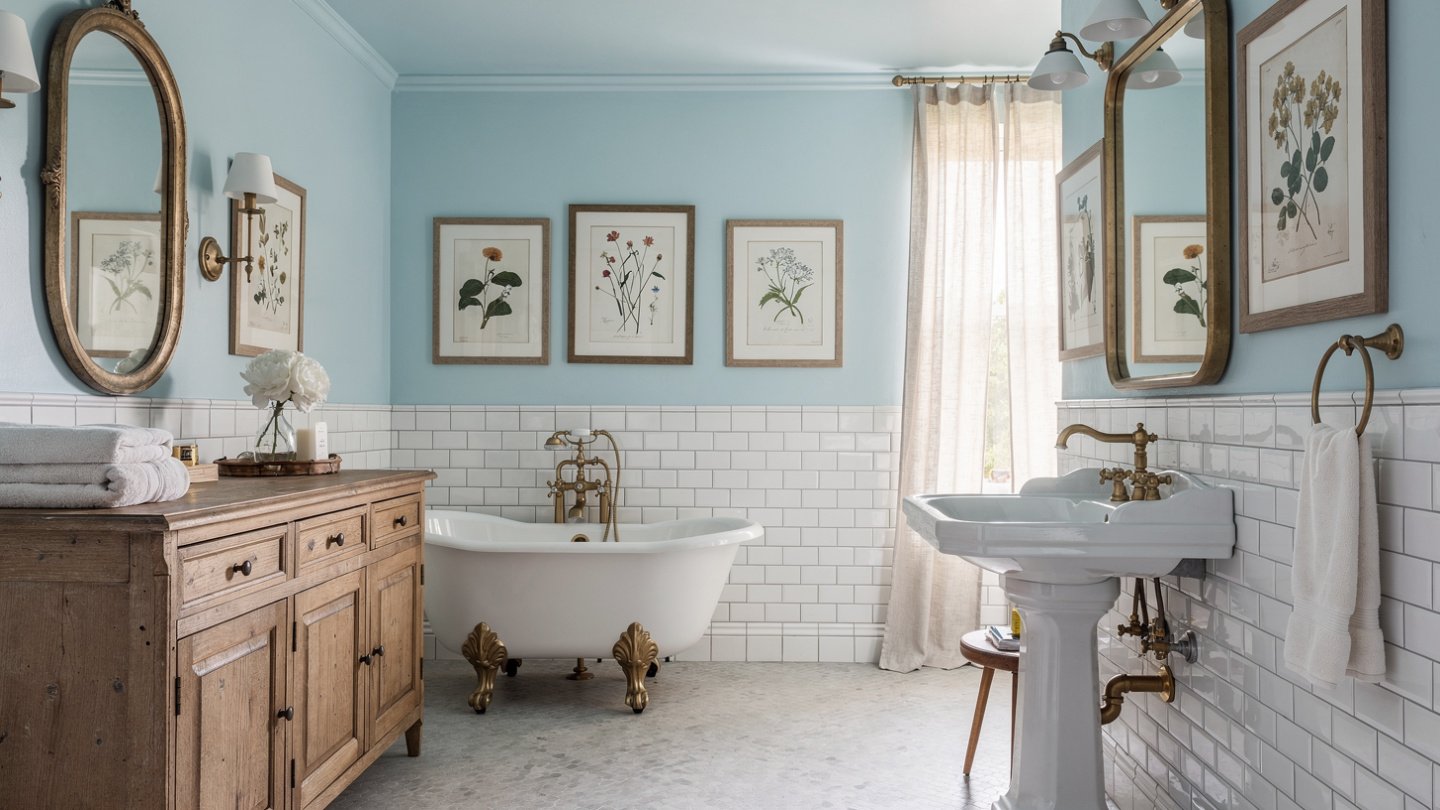
French country style in the bathroom is built on aged elegance, warm patina, botanical accents, and a deliberate acceptance of imperfection that feels authentically lived-in. It draws from the interiors of rural Provence and Normandy — farmhouses and stone cottages where natural materials, muted colours, and a deep connection to the garden have shaped every design decision for generations.
The good news for anyone who wants this aesthetic is that it is one of the most budget-friendly styles to achieve, precisely because it does not depend on everything being new, matching, or expensive. This guide explains the five defining elements of French country bathroom style, how to identify whether your current bathroom can work with it, and the specific low-cost changes that will have the greatest impact.
The 5 Design Elements That Define French Country Bathroom Style
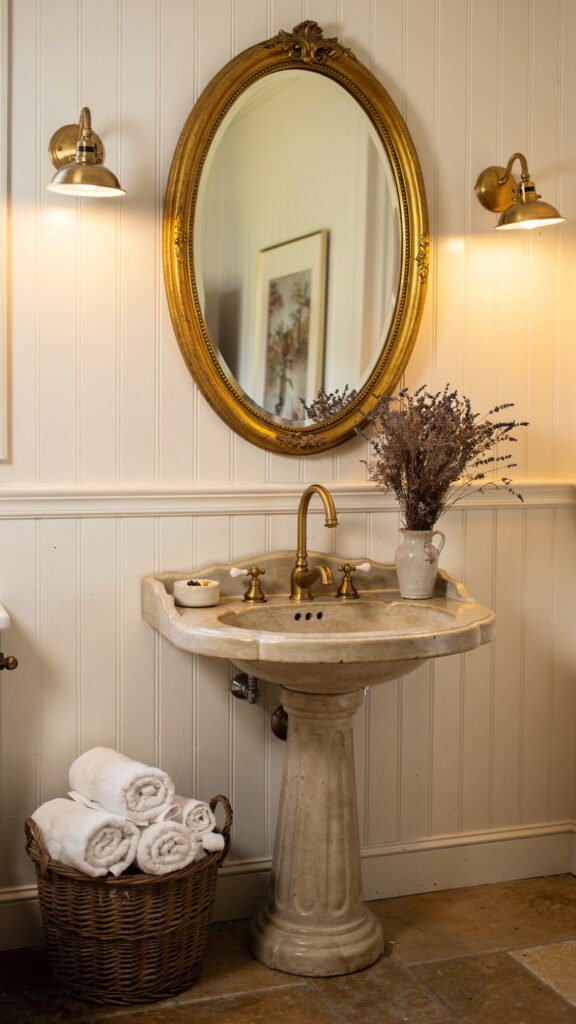
French country bathroom style is not a single look — it is a set of design principles that can be applied across a wide range of existing bathroom configurations. Understanding these five elements is the foundation for making any change that actually moves the needle on the aesthetic.
Element 1: Warm, Aged Finishes on Hardware and Fixtures
The finish of your taps, towel rails, toilet roll holder, and any other metal hardware is one of the most visible contributors to bathroom style — and one of the easiest to change. Chrome finishes are modern and cold. They belong in contemporary and Scandinavian interiors. French country bathrooms use warm metals: brushed brass, antique gold, oil-rubbed bronze, and matte gold. These finishes carry the warmth of aged materials and signal a connection to craft and tradition rather than mass production.
You do not need to replace your taps to change the metal finish in your bathroom. Towel rails, toilet roll holders, hook rails, soap dispensers, and mirror frames collectively carry significant visual weight in a bathroom — replacing these accessories with brushed brass or antique gold alternatives will shift the room’s atmosphere considerably, even if the taps themselves remain unchanged.
Element 2: A Soft, Chalky Colour Palette
The French country colour palette is built on tones that feel like they have been slightly bleached by Provençal sunlight — dusty white, warm grey, sage green, pale blue, soft terracotta, and aged cream. These are never the vivid, saturated versions of these colours. They are chalky, muted, and slightly aged in quality, as if they have been on the walls for a decade and absorbed the light of the room over time.
Bright white is too sharp for French country. Pure navy is too modern. Vivid yellow is too cheerful. The French country palette sits in the quiet, restrained register — colours that feel comfortable and unhurried rather than bold and intentional.
Element 3: Natural Materials Throughout
French country interiors are defined by their relationship with natural materials. Stone, linen, wicker, aged wood, ceramic, and terracotta all appear in a French country bathroom in forms that celebrate their natural qualities rather than trying to refine them away. A wicker basket with visible weave texture. A soap dish made from unglazed ceramic. A wooden stool with visible grain. A linen hand towel with a slightly rough texture when dry.
Plastic, chrome, and high-gloss synthetic materials are antithetical to French country style — not because they are cheap, but because they are too smooth, too uniform, and too new-looking to carry the sense of time and craft that the style depends on.
Element 4: Botanical Accents as Non-Negotiable Details
French country design has a deep and consistent relationship with the natural world, and the bathroom is no exception. A small bunch of dried lavender tied with twine. A potted herb on the windowsill. A botanical print in a simple frame. A sprig of rosemary in a bud vase. These elements are not optional decorative additions in a French country bathroom — they are fundamental to the aesthetic. They signal the connection between the interior and the garden that is central to the French country design philosophy.
Element 5: Deliberate Mismatch and Harmonious Imperfection
Perhaps the most important element of French country style — and the one most frequently misunderstood — is that things do not match perfectly. The mirror frame is a different finish from the taps. The baskets are different sizes. The towels are slightly different shades of the same colour. This is not a design failure. It is a design principle. French country interiors feel collected rather than installed, as if each piece arrived at a different time and stayed because it belonged. Perfect matching reads as modern and commercial. Harmonious mismatch reads as French country.
How to Identify If Your Current Bathroom Can Work With This Style
French country bathroom style is one of the most adaptable aesthetics available precisely because it does not depend on specific tile patterns, specific fittings, or specific architectural features. Almost any bathroom can be layered with French country elements — the starting point simply determines how many layers you need to add.
White or cream walls are an ideal starting point. If your bathroom walls are white, off-white, or pale cream — whether painted or tiled — you are already working with the base tone of a French country palette. No changes to the walls are required. You are building on a foundation that is entirely compatible with the aesthetic.
Grey or beige walls also work well. Cool grey and warm beige both sit within the muted, neutral territory of the French country palette. A grey bathroom with the right accessories, hardware, and textiles can read as confidently French country without a single wall change.
Modern chrome fixtures are the main obstacle — but only a partial one. If your bathroom has chrome taps that you cannot replace, focus your warm metal investment on the accessories: towel rail, toilet roll holder, soap dispenser, mirror frame, and hook rail. Collectively these carry more visible surface area than the taps alone, and the warmth they introduce will soften the chrome considerably.
Bold or heavily patterned tiles require more work but are not a dealbreaker. If your bathroom has dark tiles, strong geometric patterns, or a colour scheme that actively conflicts with the French country palette, you will need to work harder with accessories, textiles, and lighting to bring the aesthetic forward. It is possible, but it requires more deliberate layering.
The Budget Swap Method: 6 Affordable Changes That Have the Biggest Impact
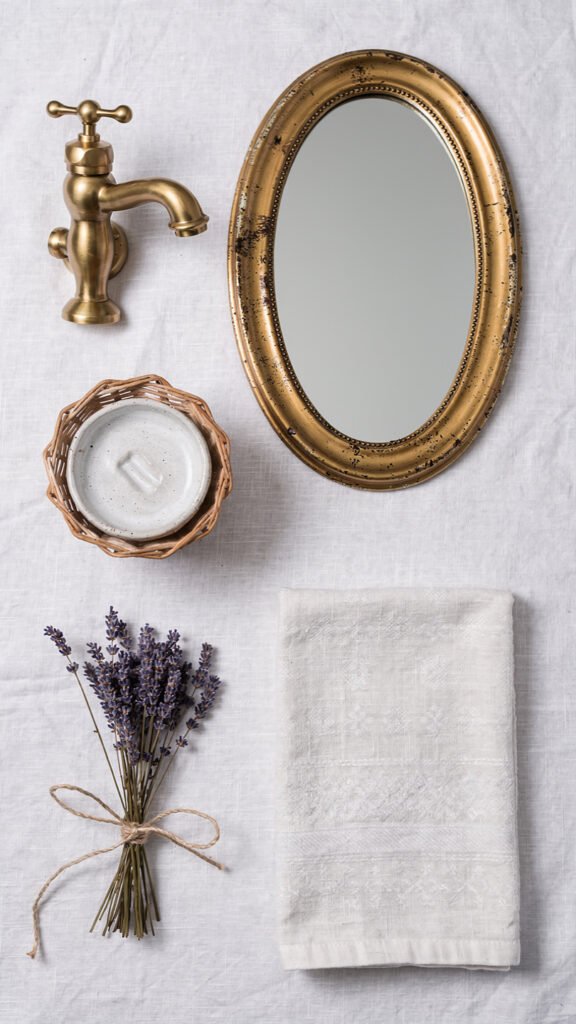
You do not need to renovate a bathroom to shift its aesthetic significantly. The following six changes, applied together, will move any compatible bathroom meaningfully toward a French country feel — most for under $50 per item.
Swap 1: Replace Chrome Accessories With Brass-Finish Alternatives
Towel rails, toilet roll holders, hook rails, and soap dispensers in brushed brass or antique gold are widely available and often priced comparably to their chrome equivalents. This single swap — removing the cold, modern chrome and replacing it with warm, aged-looking brass — changes the temperature of the entire bathroom. Brushed brass reads as aged and handcrafted. Chrome reads as modern and functional. The difference in atmosphere between the two is disproportionate to the cost of the swap.
Swap 2: Change the Mirror to an Oval or Arched Frame
A rectangular builder-grade mirror is the most common obstacle to a French country bathroom aesthetic. Rectangular mirrors are modern by default — their geometry is precise, their lines are hard, and they contribute to a utilitarian rather than romantic atmosphere. An oval mirror in a brass, gold, or aged wood frame is the single most transformative accessory change available in a bathroom. It introduces a softness and elegance that is immediately recognisable as French country in origin, and it works above almost any type of sink or vanity.
Swap 3: Add a Wicker or Rattan Storage Basket
A wicker or rattan basket — used as a laundry hamper, a storage vessel for rolled towels, or a container for bathroom products under the sink — introduces the natural material texture that is fundamental to French country style. Wicker baskets are inexpensive, widely available, and visually warm in a way that plastic or metal storage containers never are. A single well-chosen basket adds more character to a bathroom than most decorative accessories costing three times the price.
Swap 4: Replace Plastic Accessories With Ceramic or Stone
Plastic soap dishes, plastic toothbrush holders, and plastic dispensers are the most visually incongruous items in a French country bathroom. Replacing them with ceramic, unglazed stoneware, or marble alternatives costs very little — ceramic soap dishes are typically under $15 — and the difference in visual quality is immediate. Ceramic and stone carry the weight, texture, and natural variation that plastic cannot replicate, and they signal craft and quality in a way that is central to the French country aesthetic.
Swap 5: Add Dried Botanicals or Fresh Herbs
A small bunch of dried lavender tied with natural twine costs almost nothing and adds more French country atmosphere than any product purchased from a homeware retailer. Place it in a bud vase on the vanity, tie it to a towel rail, or hang it from a hook on the wall. Dried rosemary, dried eucalyptus, and dried chamomile are equally effective. If the bathroom has sufficient light, a small pot of living lavender, rosemary, or mint on the windowsill brings the connection between interior and garden that is one of the defining qualities of French country design.
Swap 6: Switch to Linen Hand Towels
Thick, fluffy terry cotton towels are a modern comfort preference — they are not a French country aesthetic choice. French bathrooms traditionally use waffle-weave linen or lightweight cotton towels that are softer in drape, quicker to dry, and considerably more elegant when displayed. Linen hand towels, in particular, are the most visible textile in a bathroom and the easiest to swap. Choose them in dusty white, warm cream, or muted sage — and fold them loosely rather than in precise hotel-style rectangles. The slightly imprecise, relaxed fold is more authentically French than a perfectly aligned stack.
Choosing the Right Colour Palette Without Repainting
Even if your walls cannot be repainted — because you are renting, because the tile colour is fixed, or because the painting budget simply is not available — you can build a French country colour palette through textiles and accessories alone. The surfaces that carry colour in a bathroom are not only the walls. Towels, bath mats, shower curtains, storage baskets, soap dishes, plant pots, and candles collectively contribute as much colour to a bathroom as the walls do, if not more.
The French country colour palette to build through textiles: dusty sage green, warm blush, muted terracotta, aged white, and soft lavender. These colours work together in any combination because they share the same muted, chalky quality — none of them are vivid or saturated, and all of them carry the warmth of natural dyes rather than synthetic ones.
A practical approach: choose one dominant colour from this palette for your largest textile — the bath mat or shower curtain — and use aged white or cream for the secondary textiles. Add one or two accent pieces in a second palette colour through accessories — a soap dish, a plant pot, a candle holder. The result is a layered, harmonious palette that reads as French country regardless of what the walls are doing.
The Botanical Element: Why French Bathrooms Always Have Plants
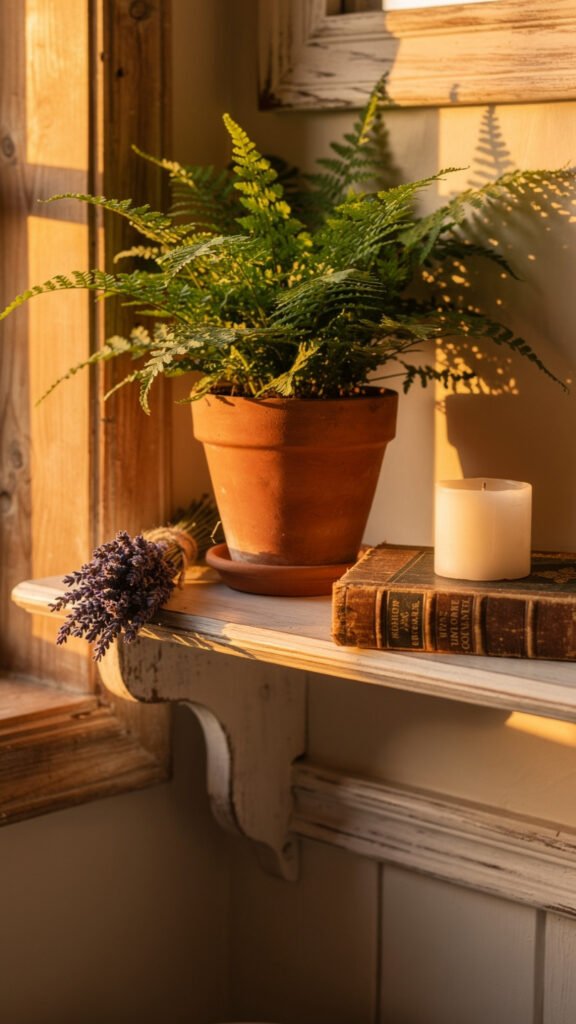
In French interior design philosophy, the boundary between the interior and the natural world is deliberately permeable. The garden comes inside in the form of cut flowers, potted herbs, dried botanicals, and botanical prints. This is not decoration in the conventional sense — it is a cultural expression of the French relationship with landscape, season, and the organic world.
In the bathroom specifically, the botanical element serves both an aesthetic and a sensory purpose. Plants and dried herbs introduce natural fragrance, living texture, and organic colour variation that no manufactured accessory can replicate. They also age and change over time — dried lavender deepens in colour, a fern grows toward the light, rosemary fills the room with its scent when the steam of a bath or shower releases its oils — and this quality of natural change is precisely what makes a French country bathroom feel alive rather than staged.
The best plants for a bathroom environment — particularly one with moderate to good natural light — are those that tolerate humidity: ferns, pothos, orchids, and peace lilies all thrive in bathroom conditions. For bathrooms with limited natural light, dried botanicals are the reliable alternative: dried lavender, dried eucalyptus, dried pampas grass, and dried chamomile require no light and no watering, and they retain their visual and aromatic qualities for months.
Common Mistakes When Trying to Achieve the French Country Look
French country style is frequently misinterpreted, and the misinterpretations tend to produce results that look more like American farmhouse, English cottage, or generic vintage than genuinely French country. The following mistakes are the most common.
Going too rustic. Overtly distressed barnwood, antler accessories, burlap, and heavily weathered finishes are American farmhouse references, not French country ones. French country is aged and warm, but it is never rough or crude. There is always an underlying refinement — a ceramic detail, an elegant curve, a botanical print in a proper frame — that keeps the aesthetic on the right side of the line between rustic charm and rural cliché.
Making everything match perfectly. A bathroom where every accessory is from the same collection, in the same finish, from the same retailer, purchased at the same time looks designed rather than collected. French country style depends on the sense that things arrived at different moments and stayed because they worked together — not because they were selected to coordinate. Deliberate mismatch within a cohesive palette is the technique. Perfect coordination is the mistake.
Over-accessorising. More is not more in a French country bathroom. A few well-chosen objects — a basket, a plant, a candle, a botanical print — create the layered, personal atmosphere the style requires. A surface covered in every French country accessory available creates visual chaos rather than cultivated elegance. Restraint is a French design value. Edit ruthlessly and let each chosen piece have space to be seen.
Forgetting texture. French country style is defined as much by tactile variety as by colour and form. A bathroom that has the right colours and the right accessories but consists entirely of flat, smooth surfaces will still feel wrong. The texture of a wicker basket, the slight roughness of a linen towel, the hand-thrown quality of an unglazed ceramic bowl, the natural variation of a stone soap dish — these textural elements are not finishing touches. They are structural to the aesthetic.
Frequently Asked Questions
What is the difference between French country and farmhouse bathroom style?
French country style is defined by warmth, refinement, and a connection to Provençal and Normandy rural aesthetics — warm metals, chalky muted colours, botanical accents, natural materials, and a sense of accumulated elegance. American farmhouse style shares the rustic material palette but tends toward rougher textures, more overtly distressed finishes, shiplap panelling, and a heavier, more utilitarian quality. French country is warmer and more refined; farmhouse is more robust and rural. The easiest distinguishing test: if it looks like it belongs in a barn, it is farmhouse. If it looks like it belongs in a Provençal stone cottage, it is French country.
What colors are used in French country bathrooms?
The French country colour palette is built on muted, chalky tones rather than vivid or saturated colours. Dusty white, warm grey, sage green, pale blue, soft terracotta, aged cream, and muted lavender are the core colours. The defining quality is that every colour in the French country palette appears slightly softened — as if bleached gently by years of natural light. Bright whites, vivid greens, and saturated blues are outside the palette.
Can I achieve French country bathroom style as a renter?
Yes — French country is one of the most renter-friendly bathroom aesthetics available because it depends almost entirely on accessories, textiles, and freestanding elements rather than fixed structural changes. An oval brass-framed mirror hung with a removable hook, linen towels, a wicker basket, ceramic accessories, dried botanicals, and a freestanding plant will collectively transform the atmosphere of a rental bathroom without leaving a single permanent mark.
What fixtures work best for a French country bathroom?
Brushed brass, antique gold, and oil-rubbed bronze are the fixture finishes most consistent with French country style. In terms of form, cross-handle taps and lever-handle taps in warm metal finishes are more appropriate than single-lever modern taps. A pedestal sink or a freestanding bath are the most authentically French country fixture choices, though neither is essential — the accessory and textile choices carry more aesthetic weight than the fixtures in most bathrooms.
Final Thoughts
French country bathroom style is not a renovation project — it is a layering process. It begins with understanding the five core elements: warm aged finishes, a chalky muted palette, natural materials, botanical accents, and the deliberate imperfection of a collected rather than designed space. It continues with a small number of well-chosen swaps — the mirror, the hardware finish, the towels, the accessories — that shift the atmosphere of the room without touching a wall or replacing a fixture.
The most important thing to remember is that French country style rewards restraint and authenticity over completeness and coordination. A bathroom with three perfectly chosen French country elements — an oval brass mirror, a wicker basket of rolled linen towels, and a bunch of dried lavender on the windowsill — will feel more genuinely French country than one filled with every relevant product from a homeware catalogue.
Choose a few things. Choose them well. Let them breathe. That, ultimately, is the French approach to interior design — and it is as achievable in a small rental bathroom as it is in a Provençal farmhouse.