
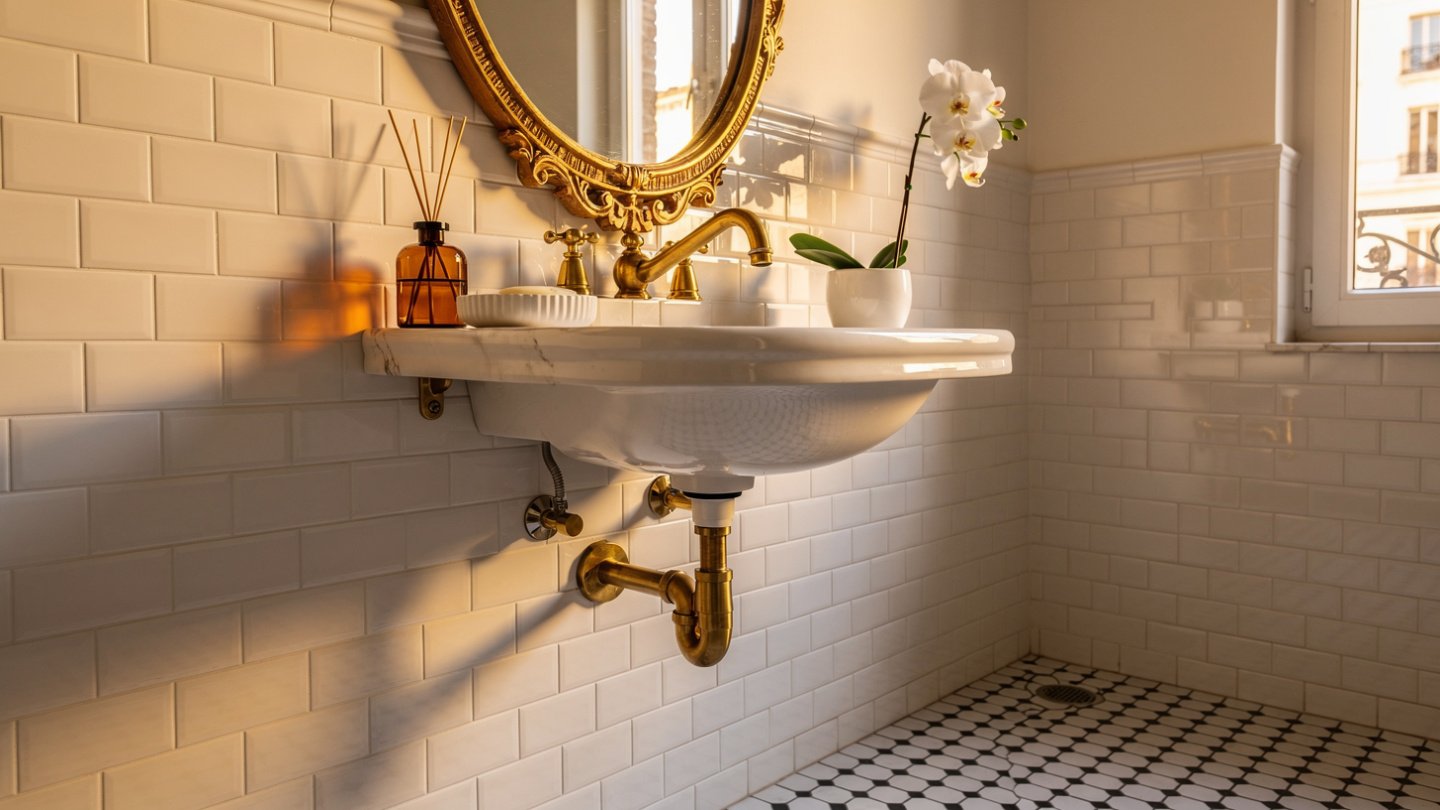
There is a quality to a Parisian bathroom that is immediately recognisable and surprisingly difficult to replicate by simply buying the right products. It is not about perfection. It is not about newness. It is not about spending more money than anyone should reasonably spend on a room used primarily for washing. It is about a specific combination of materials, proportions, objects, and — perhaps most importantly — a philosophy of beauty that embraces age, restraint, and the deliberate presence of living things.
Table of Contents
What Makes a Bathroom Look Parisian?
The sterile precision of a modern bathroom — the seamless grout, the matching chrome fixtures, the coordinated accessory set purchased as a single unit — is the opposite of the Parisian aesthetic. Where modern bathroom design tends toward the clinical and the complete, the Parisian bathroom tends toward the cultivated and the evolving. It looks like it has been inhabited by someone with taste for a long time, not installed by someone with a budget last month.
Eight specific design elements define this aesthetic. French designers return to all eight consistently, regardless of the size, age, or budget of the bathroom they are working with. Understand these eight elements and you understand not just what a Parisian bathroom looks like, but why it looks the way it does — which is the only knowledge that allows you to apply the aesthetic intelligently in your own space.
Element 1 — The Statement Mirror: Oval, Arched, or Ornate
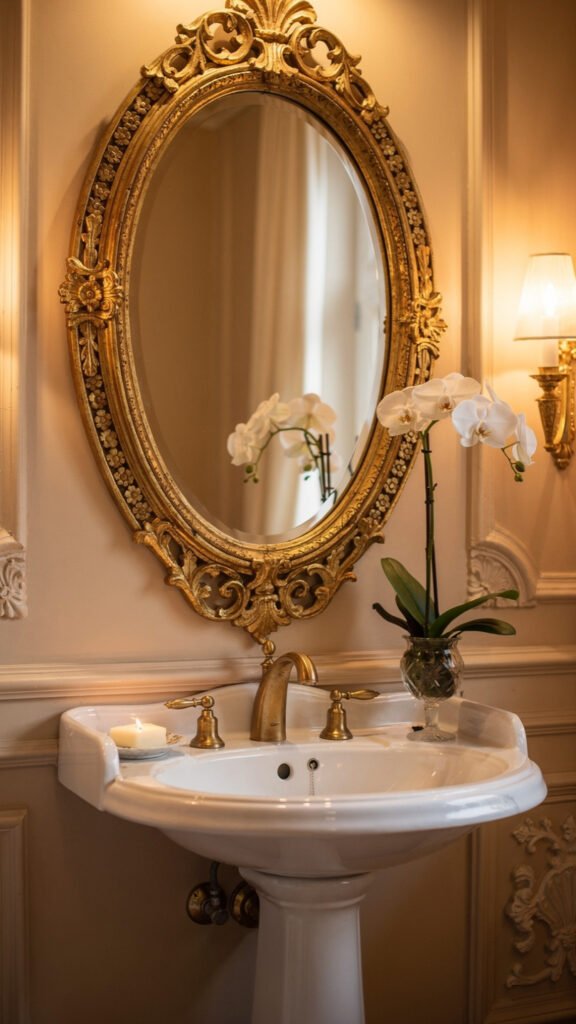
In a Parisian bathroom, the mirror is never an afterthought. It is never the rectangular, frameless, builder-grade panel that appears above the vanity in most modern bathrooms — the mirror that is there because a mirror is functionally necessary and this was the cheapest way to provide one. The Parisian mirror is a chosen object. It has a shape, a frame, a presence. It is the piece around which the rest of the bathroom’s character is organised.
The shapes that define the Parisian mirror are soft and architectural: oval, arched, round, or ornate with a frame that draws attention to itself. The oval mirror above a pedestal sink is perhaps the most iconic single element of the Parisian bathroom aesthetic — the curve of the oval against the vertical lines of the pedestal creates a visual harmony that is both classical and effortlessly elegant. The arched mirror — a rectangle with a curved top — carries the same architectural softness with a slightly more formal quality that works particularly well in bathrooms with high ceilings or period features.
Frame materials and finishes for a Parisian mirror lean toward warm metals and aged surfaces: brushed brass, antique gold, oil-rubbed bronze, aged silver, and occasionally carved or gilded wood. Chrome frames are too cold and too modern. Plain wood frames are too casual. The frame should be a feature — something that would look at home in a Haussmann-era apartment, a Normandy farmhouse, or a Left Bank studio — not something selected to avoid visual conflict with everything else in the room.
For those working within a rental or modest budget, oval and arched mirrors in brass-finish frames are widely available at accessible price points. The frame does not need to be genuinely antique or genuinely brass to read correctly in the context of the Parisian bathroom aesthetic — it needs to carry the warmth and softness of the oval or arched form.
Element 2 — Brushed Brass or Aged Gold Fixtures
The metal finish of bathroom fixtures — taps, towel rails, toilet roll holders, shower fittings, and hook rails — is one of the most powerful single variables in determining the aesthetic temperature of a bathroom. Chrome fixtures are the default of the modern bathroom, and they carry a specific set of associations: precision, hygiene, contemporaneity, and a certain clinical quality that is completely at odds with the warmth and lived-in elegance of the Parisian aesthetic.
Parisian bathrooms use warm metals. Brushed brass is the most commonly encountered — it has the warmth of gold without the ostentation, the aged quality without the heaviness of antique finishes, and a visual texture that reads as handcrafted rather than manufactured. Antique gold carries a deeper warmth and a more overtly vintage quality. Oil-rubbed bronze sits at the darker, more dramatic end of the warm metal spectrum and works particularly well in bathrooms with darker tiles or richer colour palettes.
The practical impact of changing fixture finishes in a bathroom is disproportionate to the cost and effort involved. Swapping chrome towel rails, toilet roll holders, hook rails, and soap dispensers for brushed brass or antique gold alternatives changes the entire temperature of the bathroom — even if the taps, the tiles, and the bath or shower remain exactly as they were. This is because warm metal fixtures create a series of visual anchors throughout the room that the eye connects into a coherent aesthetic character, and chrome fixtures create a different — colder, more utilitarian — set of anchors that work against the Parisian aesthetic regardless of how sympathetic the other elements are.
Where budget or rental restrictions make fixture replacement impractical, focusing the warm metal investment on the accessories — towel rail, toilet roll holder, hook rail, and mirror frame — will carry more visible impact than replacing the taps alone, because the accessories collectively occupy more surface area in the visual field of the bathroom.
Element 3 — The Pedestal Sink or a Vintage Vanity
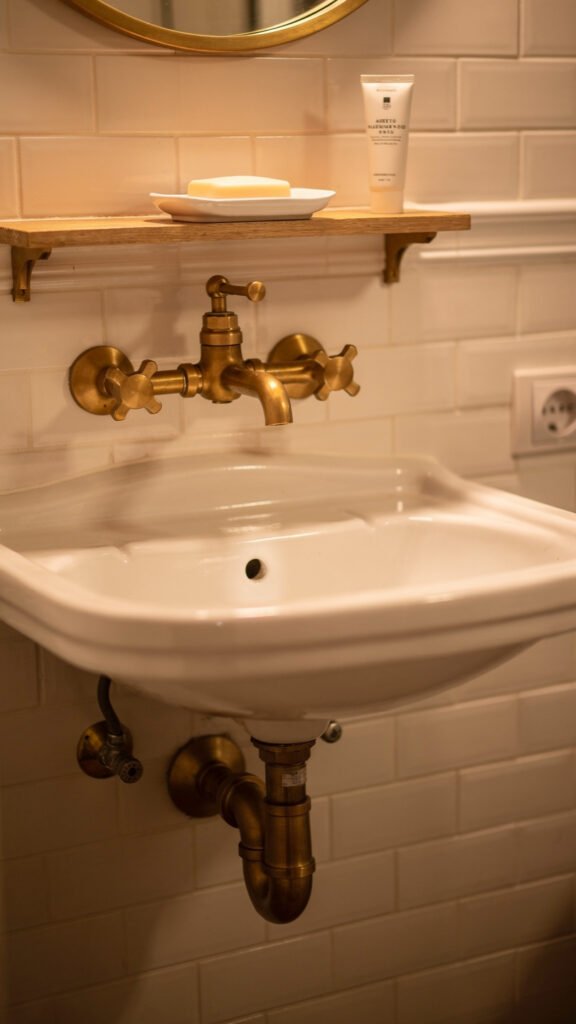
The built-in box vanity — a rectangular cabinet topped with a sink basin, with a door below for storage — is a modern American concept. It is efficient, practical, and almost entirely absent from the Parisian bathroom aesthetic. In Paris, the sink stands. It either stands on a pedestal — the classic freestanding pedestal sink whose plumbing is partially visible — or it sits on a vintage piece of furniture that has been converted into a vanity: a chest of drawers, a console table, a small dresser with a basin cut into the top surface.
The pedestal sink is Parisian by default. Its vertical form, its porcelain or ceramic material, its visible plumbing connections — which in a Parisian bathroom are not something to be hidden but something to be finished in a warm metal that makes them a feature — all contribute to the sense of an older, more architecturally considered interior. A pedestal sink with exposed brushed brass pipe work reads as intentional and elegant in a way that concealed plumbing behind a cabinet door never can.
The vintage vanity — a piece of furniture adapted for bathroom use — extends this philosophy further. It introduces the patina of an object with a previous life, the organic irregularity of a piece not designed to be a vanity but working as one, and the sense of collection and accumulation that characterises the Parisian interior at its best. A small antique chest of drawers with a ceramic basin sitting on top, connected to exposed brass pipe work coming out of the wall, is one of the most completely Parisian bathroom statements available — and one that is achievable in almost any bathroom with a standard wall connection and a freestanding sink basin.
Element 4 — Black and White Mosaic or Hexagonal Floor Tiles
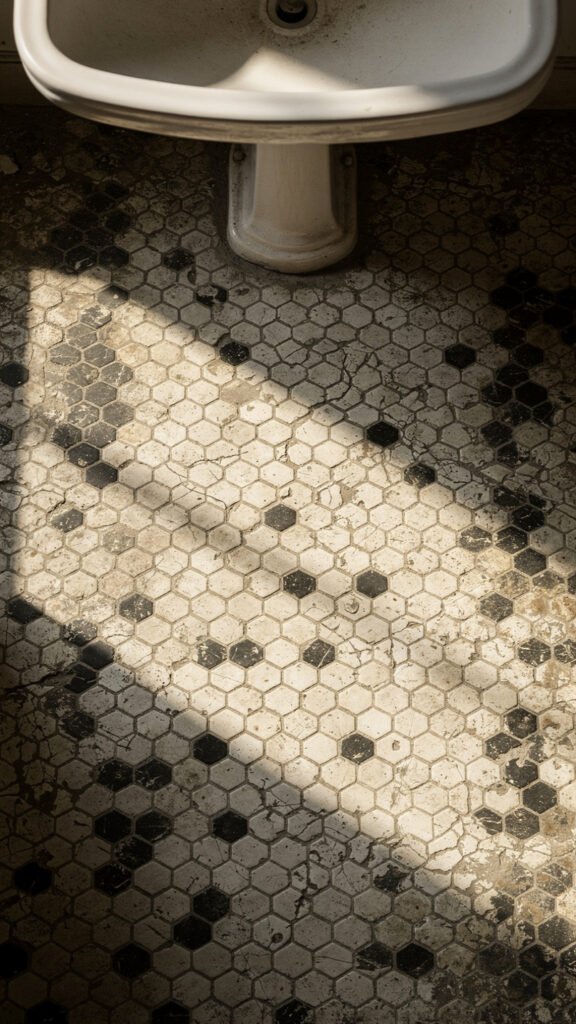
Walk into a Haussmann-era Parisian apartment bathroom and the floor is almost always the same: small black and white tiles arranged in a hexagonal or mosaic pattern, with slightly aged grout that has taken on the warmth of the building it has been in for the past hundred years. This floor tile pattern is so deeply associated with Parisian interior design that it functions as a kind of visual shorthand — the moment it appears in a bathroom, the entire room shifts toward the aesthetic it belongs to.
The small hexagonal tile — typically one inch in diameter — in a classic black and white pattern is the most iconic choice. The cement tile in a geometric or floral pattern is a close second, particularly in bathrooms with a more overtly vintage or Provençal character. Both share the quality of being pattern-forward floor choices that are confident and architectural rather than neutral and recessive.
Even in a bathroom where the floor cannot be replaced — rented properties, homes with underfloor heating, or situations where the budget does not extend to retiling — the hexagonal tile pattern can be introduced through a large bathmat or rug in a black and white geometric pattern, which, while not a perfect substitute, introduces the visual reference that anchors the rest of the Parisian aesthetic elements in the room.
For bathrooms where tile replacement is feasible, black and white hexagonal floor tiles are one of the most widely available and competitively priced tile choices in the market — their longevity of production means they are rarely treated as a premium or specialist item by tile retailers. The installation cost is higher than for larger format tiles due to the labour involved in laying small-format mosaic work, but the visual return on that investment is significant and enduring.
Element 5 — Botanical and Nature References Throughout
French interior design has a consistent and deeply rooted relationship with the natural world. The boundary between the interior and the garden — between the cultivated inside and the living outside — is deliberately permeable in French domestic design. This is not merely a decorative preference. It reflects a philosophical position about what a home is for and what it should feel like to be inside it: connected to season, to growth, to the organic world that exists beyond the walls.
In the Parisian bathroom, this connection manifests in specific, recurring ways. A bud vase with a single stem of something in season — a tulip in spring, a sunflower in summer, a branch of dried seed heads in winter. A potted orchid on the windowsill. A bunch of dried lavender tied with natural twine hanging from a hook or resting against the mirror frame. A framed botanical print — a pressed fern, a detailed illustration of a medicinal herb, a nineteenth-century flower plate — on the wall.
These elements are not optional in the Parisian bathroom. They are structural to the aesthetic. A bathroom that has the right mirror, the right fixtures, the right tiles, and the right towels but contains no reference to the natural world will read as carefully assembled but not genuinely Parisian. The botanical element is what introduces the quality of life — of something growing, changing, and present — that prevents the bathroom from reading as a stage set rather than a lived-in space.
The best plants for a bathroom environment that also serve the Parisian aesthetic are those with either structural elegance or aromatic presence: orchids for their architectural beauty and long-lasting blooms; ferns for their lush, draping texture; potted lavender or rosemary for their scent; and trailing pothos for their ease of care and organic informality. In bathrooms with insufficient natural light for living plants, dried botanicals — lavender, eucalyptus, pampas grass, and chamomile — provide the visual and aromatic botanical reference with no light or watering requirements.
Element 6 — The Linen Towel, Never Fluffy Terry Cotton
The thick, fluffy, hotel-style terry cotton towel is a very specific modern comfort preference — one that equates softness with luxury and volume with quality. It is not a French preference. French bathrooms traditionally use towels that are lighter in weight, less voluminous, and considerably more elegant in drape: waffle-weave linen, lightweight hammam cotton, and thin linen-cotton blends that dry quickly, soften with washing, and hang with the kind of relaxed, unstudied grace that no amount of tumble-drying can impart to a thick terry cloth.
The linen hand towel is the most visible towel in any bathroom — it is the one that hangs on the rail or the hook within sight of the mirror, the one that guests use, the one that contributes most directly to the visual atmosphere of the room. Replacing a thick terry hand towel with a waffle-weave linen alternative in dusty white, warm cream, or muted sage is one of the simplest and most affordable changes available in a Parisian bathroom refresh.
How the towels are displayed is as important as what they are made of. Parisian bathroom towels are folded and hung loosely — not in the precisely aligned, symmetrically centred fold of a hotel housekeeping department, but in the slightly relaxed, naturally settled way that a towel falls when someone has simply folded it and placed it without overthinking the geometry. This deliberate imprecision — the fold that is almost perfect but not quite — is a consistent feature of French interior styling across every room of the house, and it is as easily achieved in the bathroom as anywhere else.
Element 7 — A Single Signature Scent
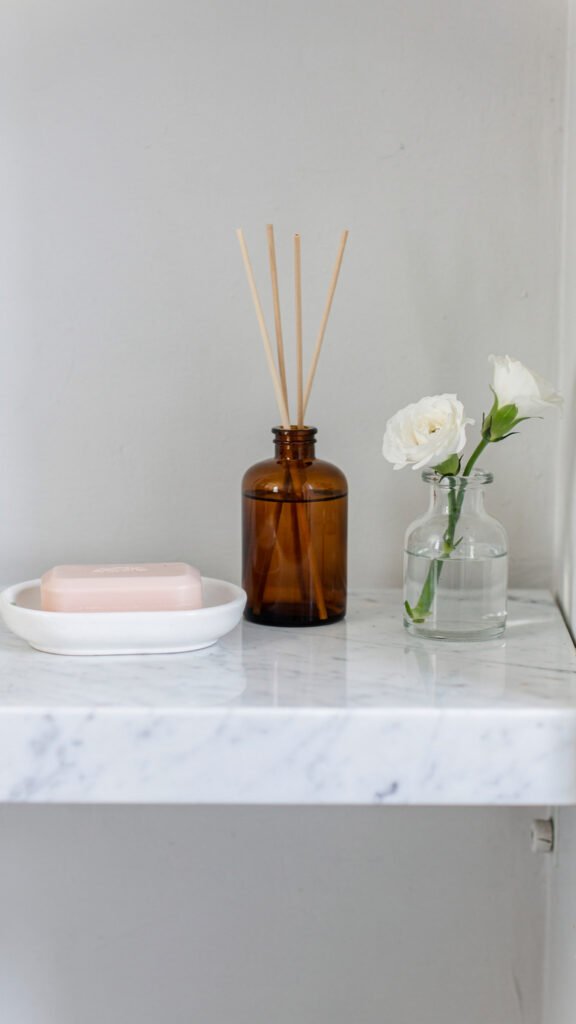
The French philosophy of restraint applies nowhere more clearly in the bathroom than in the approach to scent. A Parisian bathroom has one scent. Not a collection of candles in different fragrances accumulated over several years of gifting. Not three different reed diffusers from three different brands in three different olfactory directions. One scent, chosen deliberately, present consistently, and allowed to define the sensory atmosphere of the space without competition.
This principle of olfactory restraint is an expression of a broader French aesthetic value — the belief that refinement is achieved through selection and commitment, not through accumulation and variety. A bathroom that smells of one precise, beautiful thing — the iris and violet of a French pharmacy soap, the white musk of a reed diffuser, the fig and cedar of a single quality candle — is a more sophisticated sensory environment than one that smells of many things competing for attention.
The objects through which this single scent is delivered matter as much as the scent itself. A bar of French pharmacy soap — Savon de Marseille, Roger & Gallet, or a similar heritage brand — displayed in a ceramic or stone soap dish is both functional and beautiful. A reed diffuser in a simple glass or ceramic vessel, placed on a shelf or the edge of the bath, provides continuous fragrance without requiring attention. A single pillar candle or a small candle in a quality vessel — lit during baths rather than left permanently burning — adds the dimension of warmth and ritual to the scent experience.
The fragrance families most associated with the Parisian bathroom aesthetic are the floral-powdery register — iris, violet, rose, lily of the valley — and the clean-herbal register — lavender, rosemary, eucalyptus, fig. Both families share a quality of naturalness and restraint that is consistent with the broader aesthetic. Heavy oriental fragrances, synthetic-smelling citrus, and overtly aquatic scents sit outside the palette.
Element 8 — Imperfection Is the Point: Embrace the Patina
The eighth element of the Parisian bathroom aesthetic is perhaps the most important and certainly the most counterintuitive for anyone approaching interior design from a modern, renovation-oriented perspective. In a Parisian bathroom, perfection is not the goal. The brand-new, the flawless, the showroom-condition are not aspirations — they are, if anything, mild embarrassments. The Parisian bathroom is supposed to look like it has been lived in. Because it has been lived in. And because time, use, and the presence of real life in a space are not flaws to be remediated but qualities to be appreciated.
Slightly worn grout between floor tiles is not a maintenance failure — it is evidence of a floor that has been walked on for years by people who had somewhere to be. A mirror with a little foxing around the edges is not a mirror that needs replacing — it is a mirror with a history. A tap with a trace of patina on the brass finish is not a tap in need of polishing — it is a tap that has been used every morning by someone who values the warm metal of it enough to have chosen it and kept it.
This embrace of patina and imperfection is not an excuse for neglect or poor maintenance. Parisian bathrooms are clean. They are cared for. The towels are laundered, the surfaces are wiped, the botanical elements are refreshed when they need refreshing. The difference is between caring for a space and trying to make it look as if time has not passed in it — the former is a Parisian value, the latter is an anti-Parisian one.
Practically, this means resisting the impulse to replace things simply because they show signs of age. The oval mirror with slightly worn gilding does not need a new frame — it needs to stay exactly as it is. The ceramic soap dish with a small chip on the rim does not need to be discarded — the chip is part of its character. The linen towels that have softened and faded slightly with repeated washing do not need replacing — they have arrived at the texture and tone that linen towels are supposed to have.
It also means being deliberate about what you introduce into the bathroom. Every object in a Parisian bathroom should be chosen — not accumulated, not defaulted to, not left in place because replacing it would require a decision. Chosen for its material, its form, its patina, or its scent. And once chosen, kept with intention rather than replaced at the first sign of age.
Frequently Asked Questions
What is a Parisian bathroom style?
Parisian bathroom style is a design aesthetic rooted in the interior traditions of Haussmann-era Paris and the French apartment culture that developed within it. It is defined by warm metal fixtures in brushed brass or antique gold, statement mirrors in oval or arched frames, pedestal sinks or vintage vanity furniture, classic black and white mosaic or hexagonal floor tiles, botanical accents, linen towels, a single signature scent, and a deliberate embrace of patina and imperfection. The overarching quality it aims for is cultivated elegance — a sense of beauty that has been accumulated and lived with over time rather than installed and maintained in a fixed state.
What tiles do French bathrooms use?
The most iconic French bathroom floor tile is the small black and white hexagonal mosaic — a pattern deeply associated with Haussmann-era Parisian apartments and widely reproduced in contemporary tile ranges. Cement tiles in geometric or floral patterns are a close second, particularly in bathrooms with a more Provençal or vintage character. For wall tiles, white or cream subway tiles in a classic brick pattern are the most common Parisian choice, often with slightly imperfect or handmade-looking surfaces that add texture and warmth. Large-format, perfectly uniform modern tiles are generally outside the Parisian aesthetic.
How do I make my bathroom look French?
The highest-impact changes for introducing a French bathroom aesthetic, in approximate order of visual effect: replace a rectangular mirror with an oval or arched one in a brass or gold frame; swap chrome accessories for brushed brass or antique gold alternatives; add a botanical element — dried lavender, a potted orchid, or a framed botanical print; replace thick terry towels with waffle-weave linen alternatives in a muted neutral tone; introduce a single quality scent through a bar of French pharmacy soap, a reed diffuser, or a candle; and resist the urge to make everything match perfectly. These changes, applied together, will shift the atmosphere of almost any bathroom toward the Parisian aesthetic without structural alteration.
What is the difference between Parisian and French country bathroom style?
Parisian bathroom style is urban, apartment-scaled, and rooted in the classical architecture of the Haussmann era — it is more formal, more refined, and more architecturally specific than French country style. French country bathroom style draws from the rural interiors of Provence and Normandy — it is warmer, more rustic in its material palette, and more overtly connected to the natural landscape. The key distinctions: Parisian style favours pedestal sinks, mosaic floor tiles, ornate mirrors, and a restrained colour palette of white and warm metal; French country style favours softer colours, more natural textures, botanical accents that lean toward the garden rather than the florist, and a general warmth and informality that is less present in the Parisian aesthetic. Both embrace imperfection and patina, but in different registers — Parisian imperfection is aristocratic and architectural, French country imperfection is rural and organic.
Final Thoughts
The Parisian bathroom is not a product category. It is not a collection of items that can be purchased together from a single retailer and installed in an afternoon. It is a design philosophy — one built on warmth, restraint, patina, the presence of living things, and a fundamental respect for the idea that beauty deepens over time rather than diminishing with it.
The eight elements in this guide — the statement mirror, the warm metal fixtures, the pedestal sink, the mosaic floor tile, the botanical references, the linen towel, the single signature scent, and the embrace of imperfection — are not a checklist to be completed in order. They are a vocabulary. You can begin with one or two and build over time. You can apply all eight to a bathroom that already has the right bones, or use the most accessible ones to shift the atmosphere of a bathroom that starts from a very different place.
What unites all eight is the quality they are working toward: a bathroom that feels inhabited by someone with a considered relationship with beauty. Not someone who renovated last year and kept everything pristine. Someone who chose each thing carefully, lived with it honestly, and let time do the work that time is uniquely qualified to do.
That is the Parisian bathroom. And it is more achievable than it looks.